

For Alicia Keys and her husband, producer and music entrepreneur Swizz Beatz, born Kasseem Dean, collecting art has never been merely a matter of status. With more than a thousand works, the Dean Collection has become a significant private collection of contemporary art, focusing primarily on Black artists, identity, cultural representation, and the reexamination of the art historical canon. The collection features not only established names but also artists whose visibility within the international art world has long been limited.
The story began with Swizz Beatz. Raised in the Bronx, the producer developed an interest in fine art at an early age, initially buying works simply because he wanted to fill his home with genuine art. Alicia Keys entered this world later. As the singer recalled in an interview, her husband had been introducing her to art from the very beginning of their relationship: even their first date revolved around an experience connected to the work of Erté. Their shared passion for collecting gradually evolved into a collection in which acquiring art and personally supporting artists became inseparable.
A turning point for Swizz Beatz came in 2015, during a Kehinde Wiley exhibition at the Brooklyn Museum. Viewing the artist’s retrospective, he was struck by the realization that the institutional and commercial success of Black artists was not necessarily supported by Black collectors. This insight gave rise to one of the Dean Collection’s guiding principles: artists should receive not only inspiration and recognition but genuine economic opportunities as well.
Collecting thus became a form of cultural engagement. One of its most important expressions is the No Commission initiative, whose events allow participating artists to retain 100 percent of the proceeds from sales of their work. In the traditional gallery and art fair system, artists typically share sales revenue with intermediaries, making No Commission a deliberate reversal of the conventional business model.
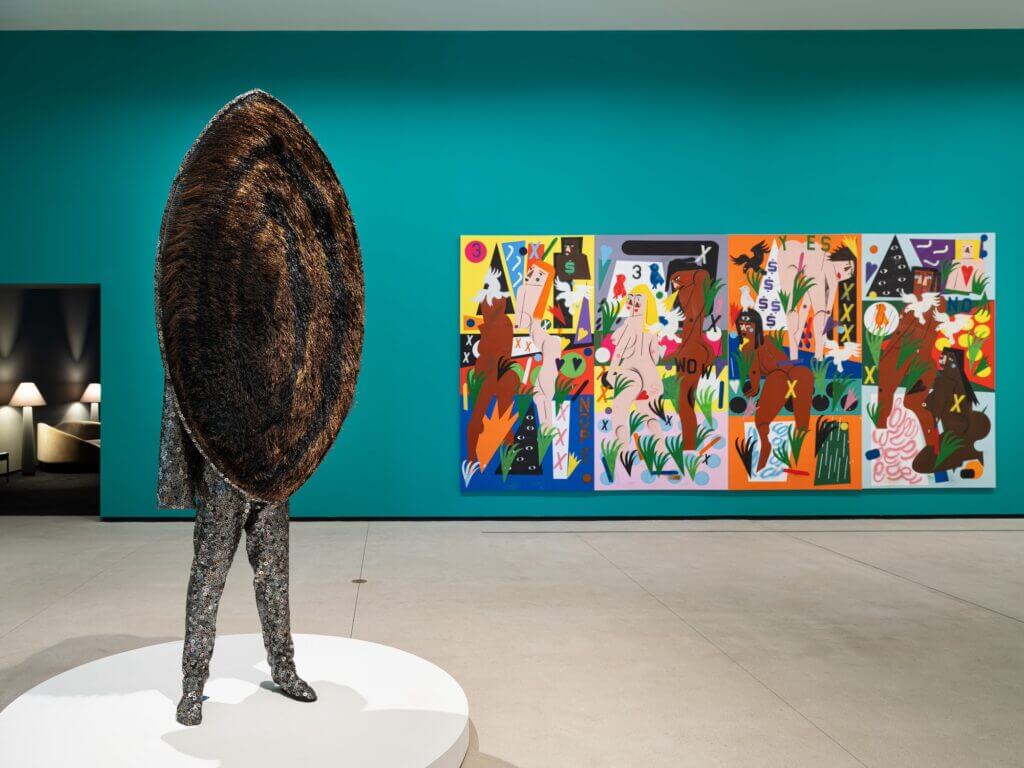
The Dean Collection, however, did not stop at direct sales. Its Giants exhibition series, also presented in museums, brought the collection to a wider audience, placing works by artists such as Jean-Michel Basquiat, Gordon Parks, Kehinde Wiley, Amy Sherald, and Mickalene Thomas alongside one another.
Their new partnership with Bonhams goes even further, addressing one of the art market’s most enduring controversies. On the secondary market, an artwork’s value can rise significantly when a previous owner resells it, yet the original artist generally receives no share of the subsequent sale. In music, such a situation would be difficult to imagine: songwriters and performers can receive royalties from the later use of their work. In the visual arts, however, particularly in the United States, this principle has not become a standard feature of the market.
Launching in November 2026, The Deans’ Choice with Bonhams seeks to address this gap through a voluntary initiative. At Bonhams auctions, sellers can commit to paying artists at least one percent of the hammer price, or a minimum of $500. The auction house contributes a matching amount, and participating artists receive their payments directly. Participation is voluntary for both sellers and artists, meaning this is not a new statutory right but an incentive system established by market participants.
The initiative’s true significance therefore extends beyond the money transferred. When an auction house incorporates the principle that artists should share in secondary-market success into its own business model, it also redefines the artist’s role. The artist is no longer simply a participant in the initial sale, whose work subsequently generates value for galleries, collectors, and auction houses, but someone entitled to participate in the artwork’s entire commercial life cycle.
What makes Alicia Keys and Swizz Beatz particularly well positioned is their understanding of both creative work and royalty systems, alongside their experience of the art market as collectors. They are not criticizing the system from the outside: they have built a major collection, developed relationships with artists, and are now attempting to bring about change through the infrastructure of an international auction house. For Bonhams, meanwhile, the partnership is more than a corporate social responsibility campaign. It is an opportunity to establish visibility for a new market standard.
The question now is whether other auction houses will follow their lead. A voluntary program alone cannot resolve artists’ vulnerability in the secondary market, but it could set a precedent. The story of the Dean Collection is therefore no longer simply about how two global superstars collect art. It is about how the influence of collectors can become a force for market reform, and how artists might finally receive a share not only when their work is created and first sold, but also when it achieves success in the years that follow.