

Nothing in William Kentridge’s art disappears without a trace. The figures in his charcoal drawings change, vanish and return in another form, yet traces of their earlier states remain visible on the paper. For the South African artist, drawing is not the illustration of a finished idea but the process of thinking itself: erasing, redrawing and uncertainty matter as much as the image. At the center of his work is a question that reaches beyond art: how can we face what a society tries to forget? Born in Johannesburg in 1955, Kentridge is one of the most versatile figures in contemporary art. He draws, makes animated films, creates sculpture, and directs theater and opera. In his work, however, all of these media serve the same purpose: to make visible the accumulated layers of history, power and human memory.
Kentridge’s thinking was shaped fundamentally by apartheid South Africa. He grew up in Johannesburg in a family where injustice was not an abstract political question. His father, Sydney Kentridge, was a lawyer who worked on cases exposing the abuses of apartheid, so racial segregation and state violence became part of the artist’s personal experience. Yet Kentridge never took the easiest path of political art. He does not make propaganda images that are easy to decode, nor does he offer a single, clear moral explanation. In his work, the absurdity of power, the inhumanity of bureaucracy and the ordinariness of violence often appear in grotesque, dreamlike scenes. The viewer is not asked to accept a ready-made statement but to find their way through a world in which the boundaries of guilt, responsibility and memory keep shifting.
It is no accident that among Kentridge’s best-known works is Drawings for Projection, the series of animated films he began in 1989. The technique seems simple, yet its effect is remarkable: the artist photographs a single charcoal drawing, alters it by erasing and redrawing, and records the change again. Rather than making a new drawing for each frame, he reworks the same surface over and over. Traces of the earlier images remain, so every scene carries the memory of what came before. This is more than a distinctive visual method; it is also a metaphor for how Kentridge thinks about history. The past cannot be erased completely. At most it can be transformed, hidden or reinterpreted. Soho Eckstein, the businessman and man of power who recurs throughout the series, becomes a symbol of an entire system as Johannesburg goes through its economic and social transformations.
This idea comes to the fore again in Kentridge’s current exhibition in London. Goodman Gallery’s A Nicely Built City, on view from September 24 to November 7, 2026, presents the world premiere of a new animated film alongside drawings, sculptures and works on paper. A Nicely Built City (Never Resists Destruction) is the twelfth film in the Drawings for Projection series. Here Johannesburg is not simply the setting of the story but the image of a fragile, constantly changing city where failing infrastructure, environmental problems and social tensions are intertwined. The new work also links images of urban decay with visual experiences drawn from other places: crumbling buildings turn into trees and other organic forms. Destruction and rebirth therefore appear not as separate events but as parts of the same process. The title comes from a West African proverb holding that even a well-built city cannot withstand destruction. Kentridge uses this idea not as a statement of fate but as a warning about the fragility of modern societies.
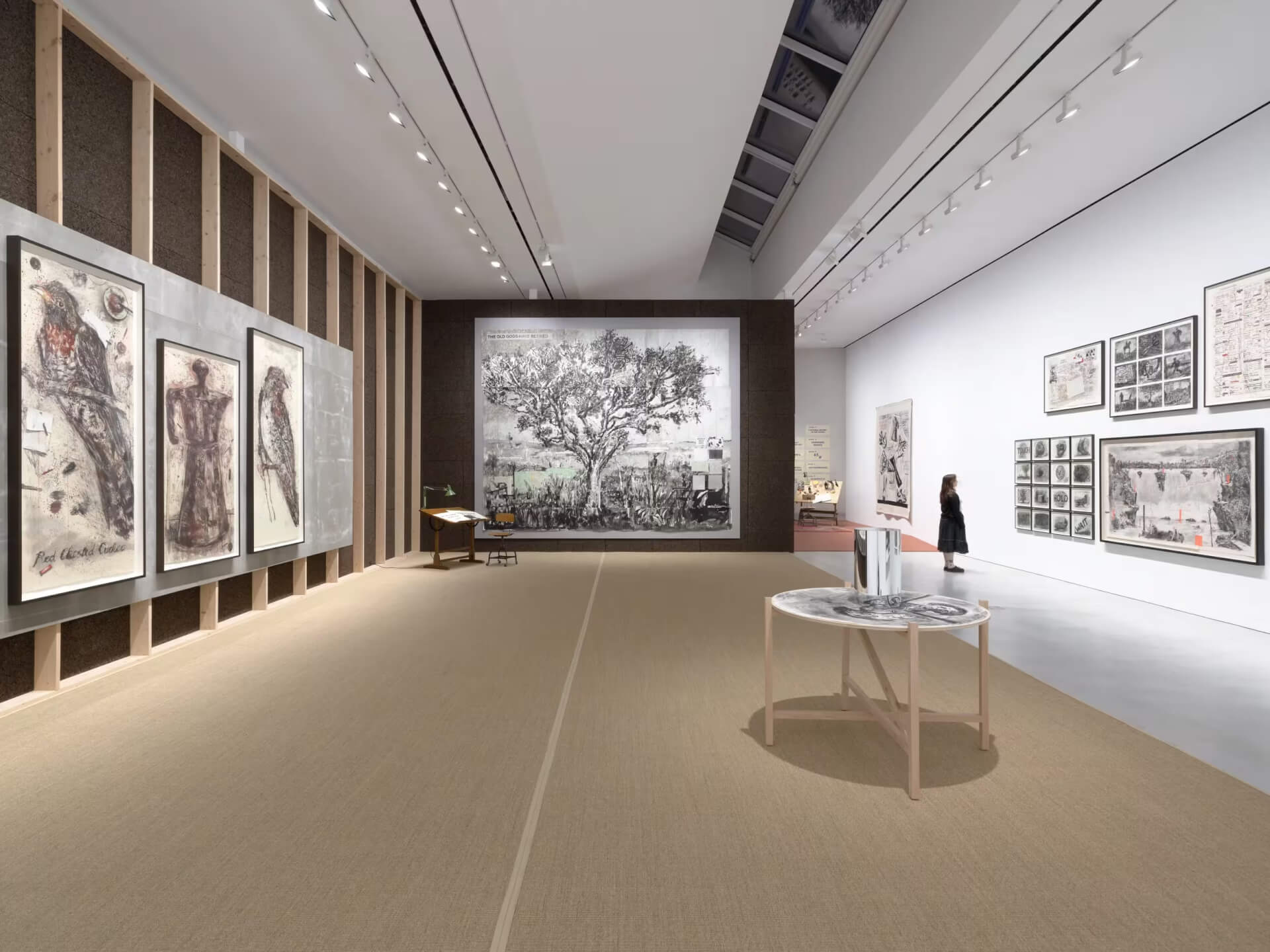
The London presentation is also significant because Kentridge is showing more than a new film; he is making the process of its creation visible as well. The original drawings are arranged to evoke the walls of his studio, so visitors see not only the finished animation but also the intermediate stages it grew out of. The exhibition also includes works connected to the artist’s 2026 production of L’Orfeo at Glyndebourne. Claudio Monteverdi’s opera tells the mythological story of Orpheus’s descent into the underworld, of loss, and of the impossibility of bringing back what has been lost. These themes are closely tied to Kentridge’s thinking about memory and disappearance. In the theater, the artist does what he does in his drawings: he places different images, sounds and movements side by side without trying to smooth over the contradictions. For him, moving between media is not simply a formal experiment but a recognition that human experience cannot be translated into a single language.
What sets Kentridge’s art apart is that its political weight never rules out humor. The grotesque figures and absurd situations often make the works unsettling precisely because tragedy and comedy cannot be separated in them. Power may look ridiculous even as its consequences are irreversible. Kentridge does not offer easily digestible solutions, nor does he claim that understanding the past automatically creates a better future. Instead, he pushes the viewer to hold several truths in mind at once, even ones that contradict each other. This approach matters all the more at a time when political and cultural debates are so often built on simplified stories and clearly designated scapegoats.
In the end, William Kentridge’s art stays relevant because it does not let us treat the past as a closed case. In his drawings, the eraser does not remove the earlier state; it reveals it. An image becomes complete not by having every mistake corrected but by preserving the history of its transformation. The same is true of societies: silenced violence, injustice and collective responsibility do not disappear just because public conversation moves on. Kentridge offers no absolution and does not promise that remembering alone will solve the problems of the present. What he shows is that facing the past is an unavoidable part of how we understand our own world. The traces of the past remain beneath the surface even when no one wants to see them anymore.