

At the age of 91, Dame Jane Goodall, the world’s most renowned primatologist, ethologist, and environmental activist, has passed away. Her life’s work represents a scientific revolution, a human statement of courage, and an endless source of inspiration—an enduring legacy that has taught generations to care for the planet and its living creatures.
Valerie Jane Morris-Goodall was born on April 3, 1934, in London. Her childhood was marked by curiosity and adventure: she examined insects under a microscope and would sit for hours in the garden waiting to see how a hen hatches from an egg. When others mocked her, her mother always defended her—“let Jane discover the world for herself.” During the war years, she grew up in Bournemouth. While many girls idolized movie stars, Jane dreamed of traveling to Africa to study wild animals. She could not afford university, so she worked as a secretary and later as a waitress, saving money to pursue her dream. In 1957, she finally boarded a ship bound for Kenya, where a fateful encounter awaited her: the paleoanthropologist Louis Leakey. Leakey immediately recognized that Jane’s curiosity and empathy were worth more than any formal education.
In 1960, Jane Goodall traveled to Tanzania, to the Gombe Stream National Park. Fieldwork was lonely and dangerous at first: she lived in a tent, battled illness, and for a time her mother joined her to provide companionship. During the first months, the chimpanzees were afraid of her, but eventually a male named David Greybeard allowed her to come close. From him, she learned that trust is born of long, patient presence. She shook the scientific world when she observed David using a twig to “fish” termites from the ground. The moment went global. The dogma of “man the toolmaker” collapsed. Goodall’s methods were revolutionary but sparked fierce debate. The fact that she gave the chimpanzees names and spoke of their emotions and motivations was seen by many researchers as “anthropomorphism.” Yet it was precisely this courage that made her a pioneer. She showed that science cannot be reduced to numbers and statistics alone—it also requires empathy and openness. Today, modern ethology takes for granted that animals have personalities, emotions, and social relationships.
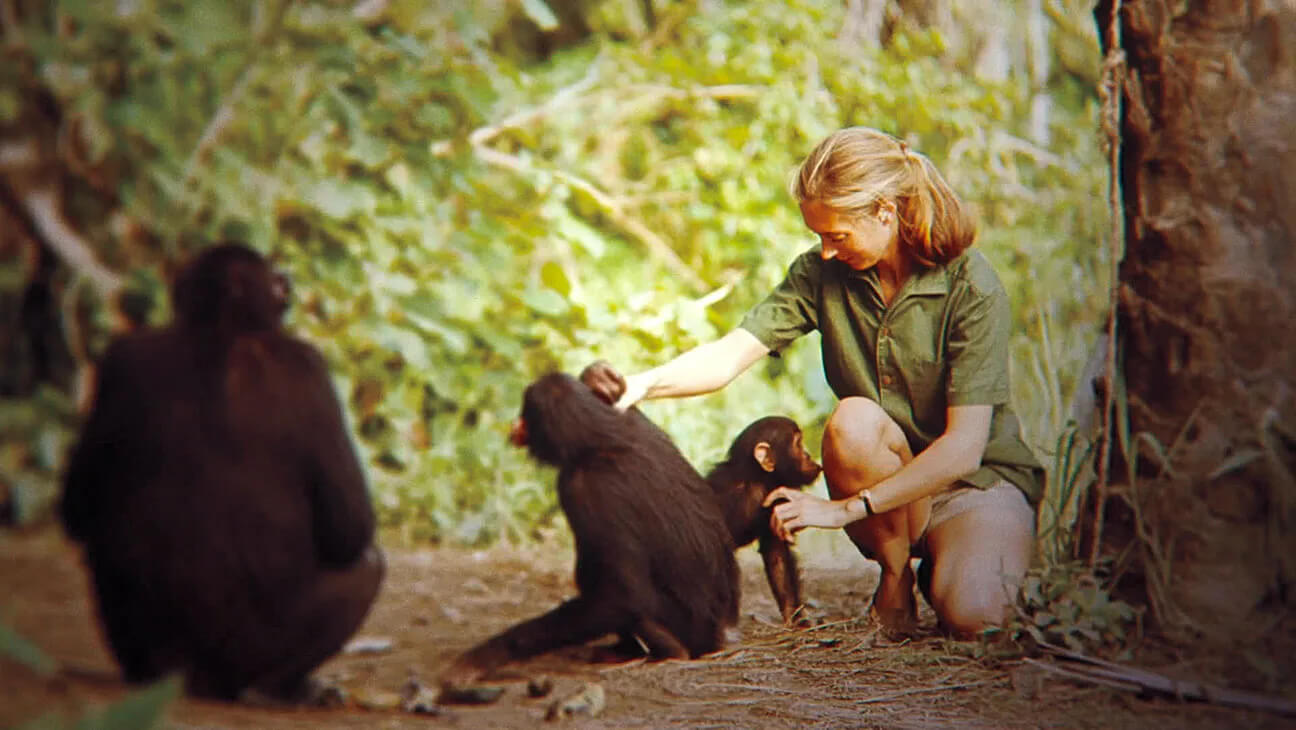
Goodall did not confine herself to academia. She wrote books, appeared in films, and gave interviews—becoming a true cultural icon whose face appeared as often on scientific stages as on magazine covers. After her years among the chimpanzees, the protection of nature became her central cause. In 1977, she founded the Jane Goodall Institute, which not only established research centers but also launched reforestation and community projects. In 1991, she started the Roots & Shoots program, which encourages young people to take action in their own communities: plant trees, clean rivers, and protect animals. Today, it operates in more than 100 countries, with millions of students involved. Goodall campaigned passionately against animal testing and factory farming and often warned of the environmental harm caused by consumer habits—especially the meat industry. While most of her contemporaries retired, Jane Goodall, even past 80, spent hundreds of days each year traveling. She gave lectures, inspired youth, and urged governments to act. By her own account, she was always driven by hope:
“People around the world are waking up. They are ready for change. There is hope—but only if we act together.”
During her lifetime, she received nearly every major scientific and humanitarian honor: the Kyoto Prize, the Tyler Prize, the title of Dame from the Queen of England, and in 2025, the United States’ highest civilian honor, the Presidential Medal of Freedom. But her true legacy lies not in medals, but in the shift of perspective she inspired. Today, most of us take for granted that animals are sentient beings and that protecting nature is key to humanity’s survival. This is largely thanks to Jane Goodall’s work. With her passing, the world has lost an icon. Yet every student who planted a tree or raised their voice for animals in her spirit carries her message forward. Her life proved that one person can transform science, awaken public consciousness, and build a bridge between humanity and nature.